 |

|
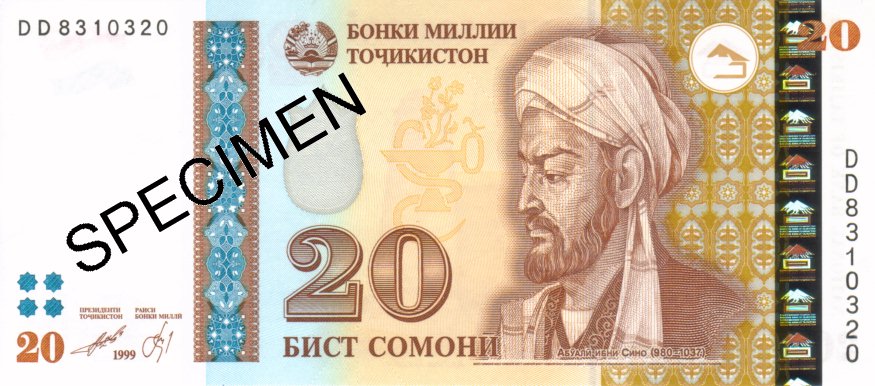
 Die von der Tadschikischen Staatsbank herausgegebenen 20-Somoni-Banknote ziert ein
Porträt von
Avicenna.
Die Darstellung auf der Banknote weist mit Heilkraut und Äskulapnatter links des
Porträts auf die Bedeutung Avicennas im Zusammenhang in der Heilkunde hin (vergleiche
auch die Angaben zu den Briefmarken). Mathematische
Leistungen werden Avicenna ebenfalls zugeschrieben.
Die von der Tadschikischen Staatsbank herausgegebenen 20-Somoni-Banknote ziert ein
Porträt von
Avicenna.
Die Darstellung auf der Banknote weist mit Heilkraut und Äskulapnatter links des
Porträts auf die Bedeutung Avicennas im Zusammenhang in der Heilkunde hin (vergleiche
auch die Angaben zu den Briefmarken). Mathematische
Leistungen werden Avicenna ebenfalls zugeschrieben.
Unterhalb des Porträts sind der Name in kyrillischen Buchstaben sowie das Geburts- und das Sterbejahr ausgewiesen.
 The 20 Somoni banknote issued by the National Bank of Tajikistan shows a portrait of
Avicenna.
The objects on the left of the portrait e. g. medicinal herb and Aesculapian snake refer to
the importance of Avicenna with respect to medicine (cf. also the information related to the
stamps),
Works on mathematics are also associated with his name.
The 20 Somoni banknote issued by the National Bank of Tajikistan shows a portrait of
Avicenna.
The objects on the left of the portrait e. g. medicinal herb and Aesculapian snake refer to
the importance of Avicenna with respect to medicine (cf. also the information related to the
stamps),
Works on mathematics are also associated with his name.
Below the portait the name in cyrillics as well the years of birth and death are provided.
| Back to the main page | Created by Wolfgang Volk in December 2010 Last change on Febrary 9th, 2020 |